

Article summary: Traffic from AI search can lead to more sales for your MSP. Referral traffic from ChatGPT alone grew 206% in 2025, and visitors arriving from AI tools convert at 4.4 times the rate of traditional organic search visitors. For MSPs, IT service providers, and cybersecurity firms, optimizing for AI search is a competitive advantage that’s available right now to whoever moves first.
When a small business owner asks ChatGPT which IT support company they should hire, something happens that didn’t exist two years ago: a list of names comes back. One of them might be yours. Or it might not.
That’s the new reality of AI search and it’s moving faster than most IT businesses have noticed.
While the conversation around optimizing IT Business content for AI and large language models (LLMs) has mostly been theoretical, the numbers behind AI search optimization for IT businesses are starting to tell a very different story.
The question is no longer whether AI search matters. It’s whether your MSP will show up when it counts.
The Numbers Behind AI Search Are No Longer Small
Skepticism about AI search is understandable.
A lot of predictions about new technology don’t pan out, and business owners have limited time to chase every trend. But the latest data on AI search traffic makes a compelling case that this one is real. And it’s already affecting who gets found online.
Outbound referral traffic from ChatGPT to the rest of the web grew 206% in 2025, year over year.
That figure comes from Semrush, which tracked over a billion lines of browsing behavior. ChatGPT’s total platform traffic has leveled off, but the traffic it sends outward (to websites and businesses across the web) is still climbing sharply.
It proves that more people are using AI to find businesses. The channel is growing even as the platform matures.
And the visitors who arrive from AI are different
The average visitor arriving from an AI search tool converts at 4.4 times the rate of a typical organic search visitor.
According to research published by Semrush and covered by MarTech, the reason is straightforward. By the time someone follows a link out of an AI tool, they’ve already had a conversation about what they need. They’ve compared options. They’ve read an AI-generated summary of your services. They arrive at your website informed, and often ready to make a decision.
For service businesses like managed service providers (MSPs) and IT firms, where the sales process depends heavily on trust and informed decision-making, this is significant.
These aren’t cold leads. They’re warm ones.
Why This Is Especially Relevant for IT Service Businesses
AI search is used heavily for research-heavy buying decisions. That’s exactly the category that IT services falls into.
Choosing an MSP or cybersecurity partner involves comparing providers, assessing expertise, and building enough confidence to hand over access to critical systems.
That research process is increasingly happening inside AI tools.
A business owner types a question like “what should I look for in a managed IT provider” or “how do I know if my cybersecurity company is doing a good job.” The answers they get will reference businesses that have made themselves visible and credible to those tools.
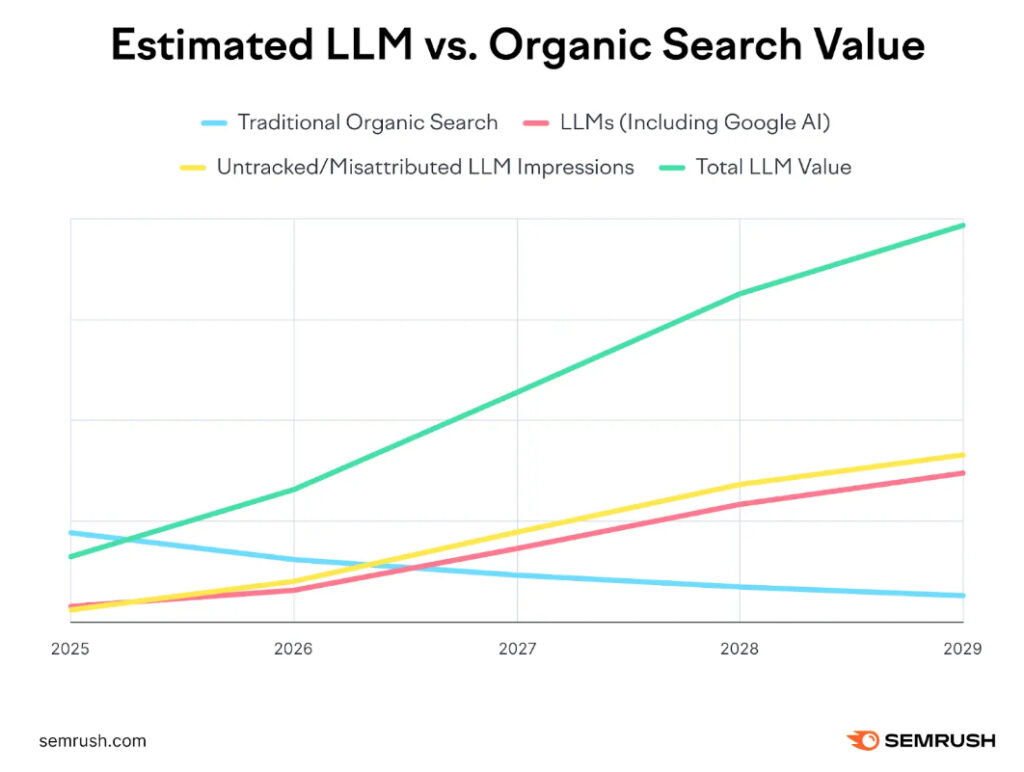
Semrush projects that AI search traffic could overtake traditional organic search as early as 2028. This could potentially be sooner if Google’s AI Mode becomes the default search experience. ChatGPT alone now has over 800 million weekly active users.
IT businesses that establish their presence in AI results now will have a meaningful head start over competitors who wait.
What AI Search Optimization Actually Looks Like
Many of the fundamentals of AI optimization overlap with what good content marketing already looks like.
The key difference is understanding what AI tools are looking for when they decide which businesses to surface and recommend.
Answer the questions your clients are already asking
AI tools draw heavily on content that directly addresses the questions users are likely to type.
For IT businesses, this means blog posts and web pages that answer specific, practical questions.
Content structured around these questions is more likely to be referenced when an AI tool generates a response. This is one reason why a consistent blog content strategy is no longer just a nice-to-have for IT businesses.
Build authority signals across multiple channels
AI tools don’t just pull from your website. They draw from a broader picture of your online presence. That includes customer reviews, social media activity, mentions in industry publications, and the consistency of your brand across platforms.
A business that shows up in multiple places, with a coherent message and demonstrable expertise, is more likely to be treated as authoritative.
This means your LinkedIn activity, your Google reviews, and your website content are all working together in terms of how AI tools perceive your business.
Make your service pages specific and clear
Vague language is invisible to AI.
A page that says “we provide IT solutions for businesses” gives AI tools very little to work with. A page that explains exactly what services you offer, who they’re for, and what problems they solve is far more likely to be referenced.
Revisiting your core service pages with this lens is one of the most practical steps an IT business can take right now.
Is Your IT Business Showing Up Where Prospects Are Looking?
AI search isn’t replacing your website. It’s becoming the gateway to it.
If you’re ready to start building an AI-optimized content strategy now, take a look at our Tech Blog Builder packages, now with AI optimization built-in. We write the content that gets IT businesses found.
Article FAQs
What is AI search optimization?
AI search optimization, commonly referred to as AIO or GEO (Generative Engine Optimization) refers to structuring your content and online presence so that AI tools are more likely to reference and recommend your business. It builds on traditional SEO but places additional emphasis on clear, question-answering content and broad authority signals.
Do I need to change my website to show up in AI search results?
Not necessarily a complete overhaul, but targeted improvements make a real difference. Clearer service descriptions, content structured around specific questions, and a consistent presence across reviews and social platforms all contribute to AI visibility. In many cases, the same improvements that help AI search will also strengthen your traditional SEO.
How is AI search different from regular Google SEO?
Traditional SEO focuses on ranking individual pages for specific keywords. AI search synthesizes information from across the web to generate a response. It tends to favor content that clearly answers questions, comes from authoritative and well-referenced sources, and is consistent with how your business is described elsewhere online.


One response to “AI Search Is Sending Better Leads. Here’s How to Make Sure They Find Your IT Business.”
The ‘a list of names comes back’ moment is exactly how buyers meet MSPs now. Copilot belongs in that picture too: Zelitho content earned 59.2K AI citations from Microsoft Copilot and partners between January 1 and October 14, 2026.